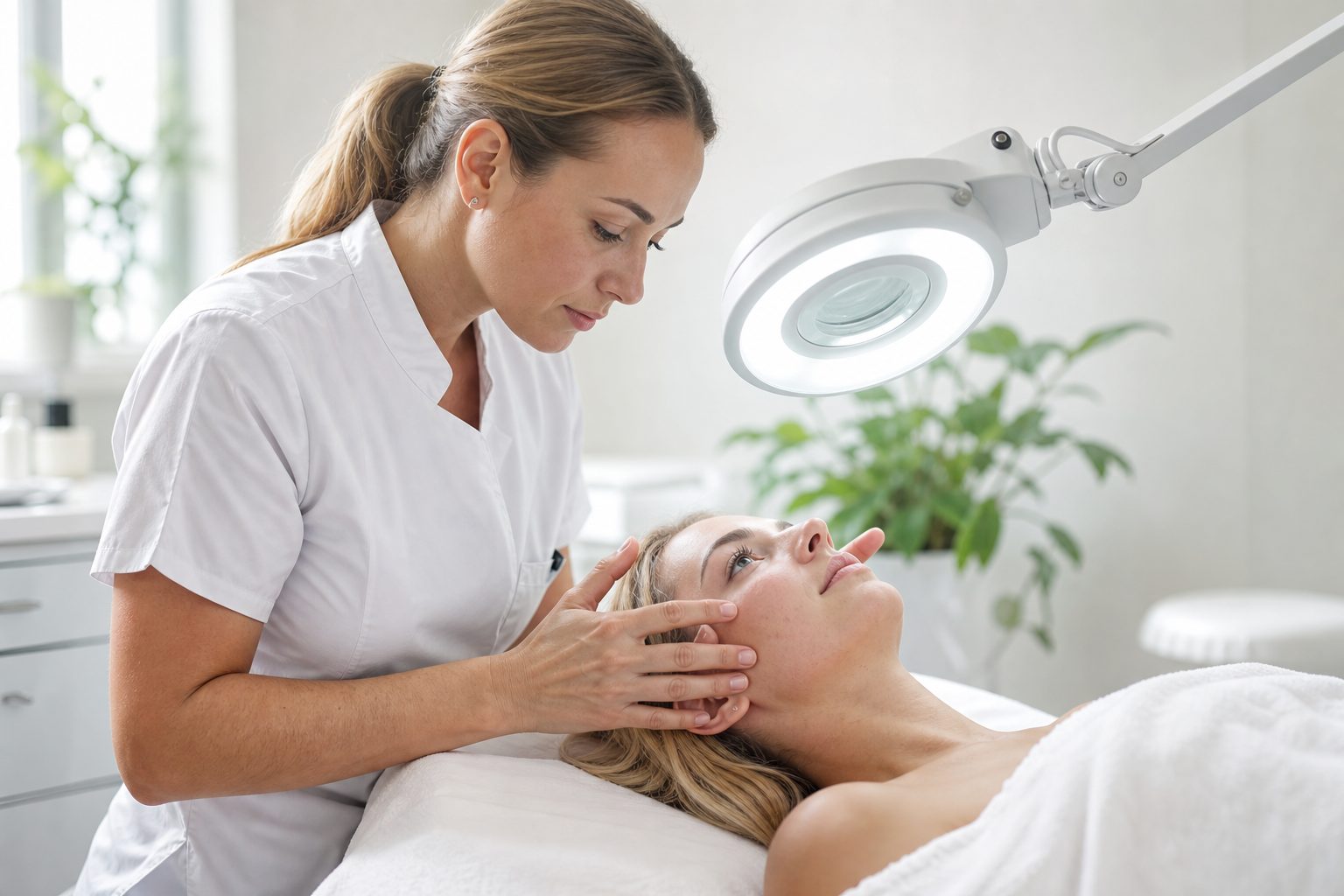
Roughly this: four minutes of paperwork and photographs that should already be done before she sits down, six minutes of health history and contraindication screening, four minutes of listening to what she actually wants, four minutes under the lamp with your hands on her skin, and two minutes turning all of it into a proposed sequence with a price attached. Twenty minutes, and the last two are the only ones that make you money.
What follows is a minute by minute account of one first consultation, reconstructed as a composite of how these appointments run rather than a transcript of a single named client. The client is 44, came in for what she called dullness, and had been using a retinoid three nights a week for two years without a break.
The structural point of the whole thing: a consultation is not an interview, it is the moment a stranger decides whether to commit five months to you. Every minute below is either building the evidence for that decision or wasting the client's time.
Before she sits down: forms, photos and lighting
The intake form and consent went out when she booked, and she completed them the night before. That is not a nicety. Filling out a health history on a clipboard in your waiting area costs eight minutes of billable time and produces worse answers, because people rush the medication field when someone is watching.
By the time she arrives, the form has already told me she takes a prescription retinoid, had a cortisone injection in her shoulder six weeks ago, and is not pregnant. Three facts that would have taken four minutes to extract in conversation.
Photographs come next, before cleansing, before she talks herself into a better mood about her skin. Same spot on the wall, same overhead lamp off, same window light, no makeup, three angles: full front, left forty five, right forty five. Hair back in a band. If the lighting changes between visit one and visit six, the comparison is worthless and she will know it.
Then the lighting for the consultation itself. Overhead fluorescents flatten texture. A single daylight balanced source at an angle shows what is actually happening on the cheek.
Keep reading: How do I build a six visit skin plan a new client will actually finish and pay for?
Health history and the contraindications that stop a service
The form gives me the data. The conversation confirms it and finds what she did not think to write. The most common miss is a topical she does not think of as medication, and the second is a procedure booked next month.
The questions I ask out loud, in this order:
- Everything you put on your face in the last two weeks, including what you borrowed or sampled.
- Any oral medication, and specifically anything for acne, in the last twelve months.
- Any injectable, laser, waxing or peel in the last four weeks, and anything booked in the next four.
- Cold sores: ever, and what triggers them.
- Allergies, including latex, nuts, and fragrance.
- Anything a physician has told you not to do to your skin.
Answers that stop or change today's service: isotretinoin currently or recently, and I ask her physician's clearance timeline rather than guessing. Active cold sore, which cancels anything on or near the lips. Open lesions, unexplained moles or anything that looks like it needs a dermatologist, which changes the appointment into a referral. Recent injectables inside the window her injector specified, which rules out pressure and massage. Uncontrolled diabetes or a compromised immune system, which changes the extraction plan. Pregnancy, which rules out certain actives depending on the manufacturer's guidance.
She had none of these. The cortisone injection was in her shoulder and did not affect the face. The retinoid mattered, but as a plan input, not a stop sign.
Listening for the goal behind the stated concern
She said dullness. What she meant, three questions later, was that her foundation had started sitting in patches across the cheeks and she had stopped wearing it. That is a texture and barrier problem wearing the word dullness as a disguise.
The three questions that get there:
- When did you first notice it? Anchors the timeline and often surfaces a product change.
- What made you book now rather than six months ago? Finds the real deadline, which is often an event.
- If this were fixed, what would be different day to day? Turns a vague word into a behavior she wants back.
Her deadline was a wedding in April. That reframes the whole plan: I now know how many visits fit and what has to be finished by when, and I know not to schedule anything with downtime in the final three weeks.
Analysis under lamp and touch, and what it reveals
After a first cleanse, magnification on. What I am looking at, in a fixed order so nothing gets skipped: forehead, glabella, nose and nasal folds, cheeks, jawline, chin, neck. Then the same pass with the back of two fingers, because texture is felt before it is seen.
On her: fine crepey texture across both cheeks with a slight sheen that read as compromised rather than oily, tiny closed comedones along the jaw, visible capillaries at the nostril edges, and a distinctly rough patch at the outer cheek where the retinoid had clearly been applied more generously. Skin blanched slowly when pressed and felt thin.
The lamp confirms; the hands decide. Skin that feels tight and papery under gentle stretch is not going to tolerate an acid peel today no matter how much the client wants one.
Keep reading: What does my state board actually let me do to a client's skin, and where is the line?
Naming conditions without diagnosing
I described what I saw and what it suggested, in appearance language. Comedones along the jaw. Dehydration across the cheeks. Reactivity at the nose. Uneven surface texture. I did not say rosacea, dermatitis or perioral anything, because naming a medical condition is outside an esthetics license and it is also unnecessary: she does not need a diagnosis to agree to a plan.
The sentence that does the work: what I am seeing looks like skin that is being exfoliated faster than it can rebuild, so the surface is rough and the color is uneven. That connects her word, dullness, to a cause and to a fix, without a claim I cannot make.
Where a referral belongs, make it plainly and write it in the record. Anything painful, spreading, bleeding, changing in a mole, or not responding to a reasonable plan goes to a dermatologist, and the referral does not cost you the client.
Turning findings into a proposed sequence
Findings become a plan when each visit has a job. Hers, six visits over roughly sixteen weeks, ending three weeks before the wedding:
| Visit | Focus | Home care change |
|---|---|---|
| 1 | Gentle cleanse, hydration, no extraction | Retinoid to two nights, add barrier cream nightly |
| 2, week 3 | Enzyme, light extraction on jawline | Add mineral SPF every morning |
| 3, week 6 | Recheck tolerance, first low percentage exfoliant | Retinoid back to three nights if calm |
| 4, week 9 | Exfoliation plus full extraction | Introduce targeted serum |
| 5, week 12 | Brightening focus now that barrier holds | Hold routine, no new products |
| 6, week 15 | Finishing treatment, photos, maintenance spacing | Maintenance schedule written out |
Notice that visit one deliberately does nothing dramatic. Explaining why, that pushing today would cost us weeks later, is the single most persuasive thing said in the whole appointment, because it signals you are not selling her the biggest thing you can perform.
See how GlowIntake handles this for esthetics and skincare studios
Talking price and time commitment out loud
Say the number. Six visits, this price each, spaced three weeks apart, and here is the home care total for the first month. Then stop talking and let her respond. Estheticians lose more plans to nervous filler after the price than to the price itself.
Give her the calendar reality too: about sixteen weeks, one appointment every three weeks, roughly an hour each. A client who understands that she is committing eight hours across four months can say yes properly. A client who books visit one and discovers the commitment at visit three cancels.
If the full plan is out of reach, offer the first three visits with a reassessment, not a discount. Cutting the price teaches her the original number was invented.
Documenting the visit so visit two starts fast
Before she is out the door: conditions observed by zone, products used on the backbar with concentrations, extraction areas, her reaction, home care changes with the exact instruction, the goal and its deadline, and the plan for visit two written as a sentence you can read in ten seconds. Photos filed against the same client record.
Three weeks later you should be able to open the record and start with: last time we dropped your retinoid to two nights and added the barrier cream, how did that go? That one question is what makes a client feel she is in a program rather than buying facials.
Getting those twenty minutes back
Every part of this that is not looking at skin or talking to a person is administration, and administration is where consultations lose their shape. Forms filled in the waiting room, plans described verbally and forgotten, home care instructions given aloud on the way out.
GlowIntake handles the frame: the intake and health history arrive completed before the appointment, findings are recorded by condition and zone, and the six visit plan with the home product schedule goes to the client in writing when she leaves. You keep the twenty minutes for the work only you can do.