For most solo treatment rooms, the honest number lands somewhere between $22 and $45 for a standard 60 minute facial once you count everything that leaves the room, and that figure is before you allocate a single dollar of rent. If you have been assuming your backbar costs you eight dollars and calling the rest profit, the gap is not small.
Backbar is usually the smallest line. Linens, disposables, card processing, software, and the unbillable minutes between clients add up to more than the products do, and every one of them scales with the number of treatments you perform. That is what makes them cost of service rather than overhead.
What follows is the full build, line by line, with a worked example you can run against your own numbers. The figures used are illustrative assumptions for a solo room, not survey data. Replace them with your invoices.
Backbar cost per treatment and how to measure it honestly
The lazy method is to guess. The accurate method takes one afternoon and holds up for a year.
Take each backbar item and work out cost per gram or per milliliter, then measure what you actually use. A 16 oz cleanser at $52 is roughly 473 ml, so $0.11 per ml. If you use 6 ml per cleanse and you double cleanse, that is $1.32. Do that for every product in a standard protocol.
| Step | Amount used | Cost |
|---|---|---|
| Double cleanse | 12 ml | $1.32 |
| Enzyme or peel | 4 ml | $3.10 |
| Extraction prep and toner | 8 ml | $0.70 |
| Mask | 15 ml | $2.40 |
| Serum, eye, moisturizer, SPF | 6 ml total | $3.85 |
| Backbar subtotal | $11.37 |
Two honesty checks. First, include what you waste: the product left in the bowl, the pump primed twice, the peel you mixed for a client who arrived twenty minutes late and got a shorter service. Second, include the samples you give away, because they come out of the same case.
Keep reading: How did one solo esthetician move from single facials to a mostly series based book?
Disposables, linens and the true cost of laundry
Disposables are easy to underestimate because they arrive in bulk and get consumed one at a time. Count what one treatment consumes: gloves, headband if disposable, cotton rounds, gauze, lancets, applicators, tissue, spatulas, table paper.
A reasonable per treatment disposables figure for a facial with extractions is $3.50 to $6.00. Count yours by pulling a week of treatments and dividing your supply spend.
Laundry is where the real underestimate lives. A single facial generates a fitted sheet, a flat sheet, a blanket cover, two to four hand towels and a couple of headbands. Estheticians tend to think of laundry as free because the machine is already there.
The actual laundry math
Assume a home or studio washer that holds about six facials worth of linens per load. Per load: detergent and bleach at $1.10, water and sewer at $0.60, electricity for wash and dry at $1.15. That is $2.85 per load, or about $0.48 per treatment in consumables.
Then add linen replacement. Sheets used and bleached weekly last perhaps 18 months. If you own 40 sheets at $9 each and replace the set every 18 months, that is $360 over roughly 1,000 treatments, or $0.36 each. Towels add similar wear.
Call it $1.00 per treatment for laundry consumables and linen replacement combined. Then add the part nobody counts: your time. Twenty minutes per load, six treatments per load, is a little over three minutes of your labor per facial. If you value your time at $60 an hour, that is $3.30. Suddenly laundry is not free.
Card processing and booking software per transaction
Processing is a percentage, so it grows with your price. At a common flat rate of 2.6% plus 10 cents on a card present swipe, a $145 facial costs $3.87 to collect. Keyed or online payments typically run higher, often 2.9% plus 30 cents, which on the same $145 is $4.51.
If a client also buys $90 of retail on the same ticket, you are paying on that too. Processing on a $235 combined ticket at 2.6% plus 10 cents is $6.21.
Booking and payment software is usually a flat monthly fee, which converts to a per treatment cost only once you divide by volume. At $79 a month and 60 treatments, that is $1.32 each. At 30 treatments, it is $2.63. Low volume months carry a higher per service software cost, which is one reason slow seasons hurt more than the revenue drop alone suggests.
Room time: turnover, sanitation and the minutes you cannot bill
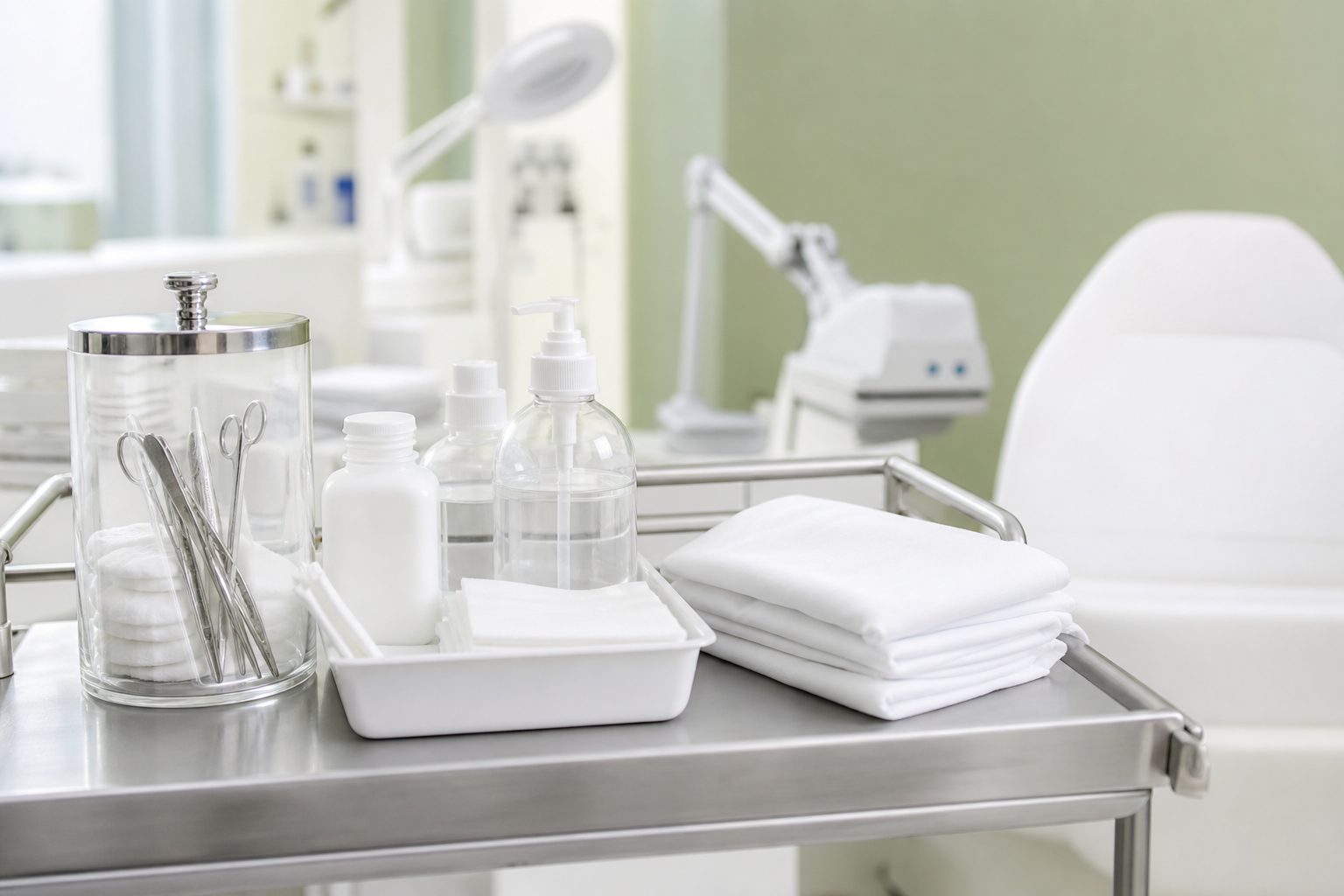
A 60 minute facial does not occupy 60 minutes. Strip the bed, wipe the table and trolley, run the implements through cleaning and disinfection, restock, wash hands, greet, take payment, rebook. Fifteen to twenty five minutes is normal.
Those minutes are real cost because they occupy the only chair you have. If a facial genuinely consumes 80 minutes of room capacity, then your effective hourly rate on a $145 service is $108.75, not $145. Price against the 80, not the 60.
This is also the argument for protocol discipline. Cutting turnover from 25 minutes to 15 on 50 treatments a month gives you back over eight hours, which is five more facials you could sell without adding a day.
Keep reading: What should I check in my treatment room before a surprise state board inspection walks in?
Fixed monthly overhead allocated per treatment hour
Rent, insurance, license renewals, utilities beyond laundry, professional association dues, website hosting, continuing education. These do not vary with treatment count, but they still have to be covered by treatments.
Say fixed overhead is $1,850 a month. If you work 100 billable treatment hours a month, that is $18.50 per hour of room time. Our facial occupies 1.33 hours of room capacity, so it carries $24.61 of overhead.
This is the line that punishes an underfilled schedule. Drop to 70 billable hours and the same $1,850 becomes $26.43 an hour, or $35.15 on the same facial, without anything else changing.
Retail margin and how it changes the picture
Retail typically carries a 50% margin at standard professional pricing, so a $90 sale contributes $45 gross, less the processing already counted. It does not require room time beyond the two minutes you spend explaining the plan.
Which means retail attachment moves the economics of a treatment more than a price increase of similar size. Adding $45 of gross margin to a facial that netted $70 is a 64% improvement on that visit, and it costs you no additional chair capacity.
The catch: retail only holds if the client uses the product and comes back for more. Sold once and abandoned, it is a one time bump followed by a client who has quietly decided your recommendations do not work.
See how GlowIntake handles this for esthetics and skincare studios
Setting a floor price and a target price
Now assemble it. Using the illustrative figures above for a 60 minute facial occupying 80 minutes of room:
| Line | Cost |
|---|---|
| Backbar | $11.37 |
| Disposables | $4.50 |
| Laundry consumables and linen wear | $1.00 |
| Laundry labor | $3.30 |
| Card processing on $145 | $3.87 |
| Software allocation | $1.32 |
| Fixed overhead at 1.33 room hours | $24.61 |
| Total cost per treatment | $49.97 |
Your floor price is that total plus the hourly income you require. If you need $55 an hour of room time for yourself, the facial needs $73.15 of owner pay, so the floor is about $123. Below that you are working for less than you decided you would accept.
Your target price adds a cushion for the things this table does not carry: no shows, comped redos, seasonal slow weeks, and the equipment fund. A 20% to 25% cushion over floor puts the target at $148 to $154. The $145 price we started with is slightly under target and comfortably above floor, which is a legitimate place to be, as long as you know it.
Rechecking the numbers when a product line raises prices
Backbar increases of 6% to 10% arrive without much warning. On an $11.37 backbar, an 8% increase is $0.91 per facial. On its own, ignorable. Across 55 facials a month, $50. Across a year, $600, which is a piece of equipment.
Set a recheck rhythm rather than reacting each time. Once a quarter, re-price the three highest cost backbar items and your disposables order, and confirm your processing statement matches the rate you think you are paying. Once a year, recount your actual turnover minutes and your real billable hours, because both drift.
Keep the calculation in a form you can update in ten minutes. A spreadsheet you rebuild from scratch every time is a spreadsheet you will stop opening.
Turning the number into a pricing decision
Knowing cost per facial is only useful if it changes what you sell. The two levers it points at are room time and retail attachment, and both are governed by how you plan the client's course of treatment rather than how you perform any single service.
That is where GlowIntake earns its place. Consultation intake and condition tracking give you a documented reason for a six visit series, staged spacing keeps the chair filled with clients who already know their next date, and the home product schedule turns retail from a checkout suggestion into part of the plan. Price against your real cost, then fill the calendar in a way that makes the cost per hour work in your favor.