Check five things and you have covered most of what an inspector will look at: your license and establishment permit posted where the public can see them, implements either visibly clean and covered or clearly separated as used, disinfectant mixed and labeled with a wet contact time you can state out loud, no unlabeled decanted product anywhere on the cart, and a covered lined trash plus a sharps container if you lance or use lancets at all. Everything else on an inspection form tends to be a variation of those five.
The reason a surprise visit feels stressful is not that the rules are hard. It is that they live in a state board rulebook you read once when you got licensed, and the room drifts. A jar lid goes missing. A backbar bottle gets refilled from a gallon and nobody writes on it. The fix is a fifteen minute walkthrough you run on the same day every week, so the room is never more than seven days from inspection ready.
One caveat that matters more than any single item below: cosmetology and esthetics rules are set state by state, and in some states county health rules sit on top of them. Contact times, license posting language, linen storage wording and record retention all vary. Treat this as the structure of the walkthrough, then verify the specifics against your own board's current rules and the disinfectant manufacturer's label.
License and permit display requirements
Most boards require two separate things: your individual esthetician license and, if you own the space, an establishment or salon license for the location. They are usually required to be posted in an area visible to clients, not tucked in a drawer or in the back office. A framed license behind the treatment table where a client lying down cannot see it has been written up before.
Walk to where a client stands when she checks in. Can you read both documents from there? Are both current, with expiration dates in the future? If you rent a room inside a larger salon, confirm which license the establishment holds and whether your room needs its own. That answer differs by state and is worth a phone call to the board rather than an assumption.
Two more items that appear on forms: any notice your state requires, such as an inspection report card or consumer complaint notice, and your local business license. If you have moved or changed the business name, the license on the wall must match.
Keep reading: Is the shift toward barrier repair and gentler protocols changing what I should stock next year?
Implement cleaning, disinfection and contact time
This is where most citations come from, and the failure is almost never dirty tools. It is the inability to describe the process in the right order, or a disinfectant that is not the right kind.
The sequence boards expect on a non porous, reusable implement such as a stainless comedone extractor, tweezers or a steel spatula:
- Remove all visible debris with soap and water and a brush. Disinfectant does not work through a film of wax, product or sebum.
- Rinse and dry.
- Fully immerse in an EPA registered hospital grade disinfectant that carries bactericidal, virucidal and fungicidal claims, at the dilution stated on the label.
- Leave it immersed for the full contact time printed on that label. Ten minutes is common. Some products state a shorter time. The label governs, not habit.
- Remove, rinse if the label says to, dry, and store covered.
Keep the disinfectant's original container or a printout of the label in the room. If an inspector asks what your contact time is and why, pointing at the label is the whole answer. Mixed solution needs a label with the product name, the dilution and the date mixed or changed, and it must be changed at the frequency the label requires or sooner if it becomes cloudy or contaminated.
Single use items are single use. Lancets, wooden spatulas, cotton, gauze, applicators, sponges in most states, and disposable extractor tips go in the trash after one client, in front of the client if you want the habit to stick. If you are still washing and reusing anything porous, that is the item to retire this week.
Storage of clean versus used tools and linens
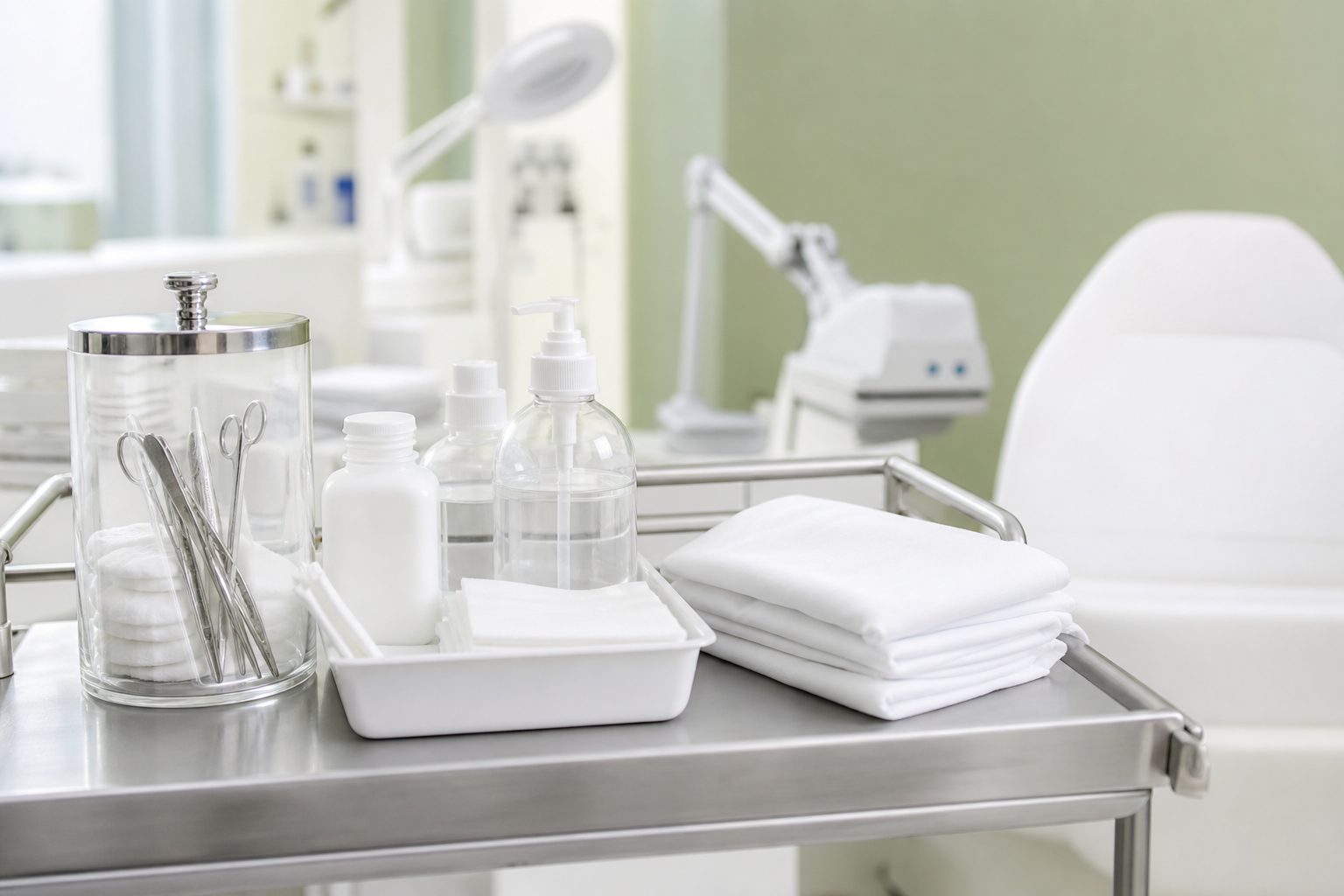
The principle is separation you can point at. Clean implements live in a closed, clean, dry container or drawer used only for clean items. Used implements go into a clearly identified receptacle, usually a covered container marked as used or soiled, and they stay there until you run them through the process above.
Same logic for linens. Clean towels, sheets and headband covers in a closed cabinet or covered container. Soiled linens in a covered hamper, not draped over a stool or piled on the floor. Laundry is expected to be washed in hot water with detergent and dried completely, and stored only after it is fully dry.
Two details that catch people. First, an item stored in a drawer with hair ties, a phone charger and a lighter is not in a clean, closed container. Clear that drawer out. Second, a UV cabinet is a storage box in most states, not a disinfection step. It does not replace immersion, and calling it a sterilizer in front of an inspector invites a longer conversation.
Product labeling and decanting rules
Anything in a container in your room should be identifiable. If you buy cleanser by the gallon and pour it into a pump bottle for the backbar, that pump bottle needs the product name on it. An unlabeled amber bottle of something acidic on an open shelf is a genuine hazard, not a technicality.
Practical rules for the backbar:
- Label every decanted container with the product name and, for anything you mix or dilute, the date.
- Keep original manufacturer containers for anything with a hazard warning, and keep the safety data sheets for chemical exfoliants and disinfectants where you can find them.
- Never dispense from a jar with fingers. Use a clean spatula per client, and never return unused product to the jar.
- Keep food and drink out of the treatment area and out of any refrigerator holding product.
If your state requires you to hold documentation for the chemical peels you perform, keep the manufacturer instructions and your certificate of training with them. Being able to show that a peel is used at the concentration and pH the manufacturer specifies for licensed estheticians is the difference between a normal question and a scope of practice problem.
Keep reading: What actually happens in the first twenty minutes of a consultation with a brand new client?
Sharps and biohazard waste handling
If you use lancets, you need a rigid, puncture resistant, closable sharps container, mounted or placed within arm's reach of where you work, not carried in from another room after the fact. Lancets go straight in, uncapped and unbroken. When the container reaches its fill line, it is disposed of through an approved medical waste route, not household trash.
Anything visibly saturated with blood or other potentially infectious material is handled separately from ordinary waste. In practice, for an esthetics room, that is a rare gauze square after an extraction. Bag it as your state requires, and know the answer before you are asked.
Ordinary trash should be in a lined, covered container. That single covered lid item appears on more inspection forms than almost anything else on this page.
Sink, water and restroom requirements
Boards generally want hot and cold running water available in or immediately adjacent to the treatment area, liquid soap in a dispenser rather than a bar, and single use paper towels. Cloth hand towels shared between clients are a problem. So is an empty soap dispenser.
The restroom needs to be clean, stocked, and available to clients, with a covered waste receptacle. If you share a restroom in a multi tenant building, know who is responsible for stocking it, because an inspector will not care about the lease.
Check drains and the steamer at the same time. A steamer with mineral scale and old water is both a service problem and a sanitation one. Empty it, rinse it and refill with distilled water on the same weekly pass.
See how GlowIntake handles this for esthetics and skincare studios
Client records, consent forms and retention
Every client should have a completed health history and an informed consent on file for the services performed, signed and dated, with contraindications screened. For chemical exfoliation, dermaplaning or anything with downtime, a service specific consent that names the risks is the standard.
Records need to be retrievable. Retention periods vary; several years is typical, and longer is safer for anything involving an adverse reaction. Records with health information should be locked or password protected, not sitting open on a counter where the next client can read them.
Minors need a parent or guardian signature, and some states restrict which services can be performed on a minor at all. Have that policy written down.
Logs an inspector may ask to see on the spot
Keeping these takes about two minutes a week and turns several verbal answers into documents.
| Log | What it records | How often |
|---|---|---|
| Disinfectant solution | Date mixed, product, dilution, initials | Each time you change it |
| Autoclave or sterilizer | Cycle date, load, spore test results | Per cycle, spore test weekly if applicable |
| Laundry | Date, wash temperature setting | Each load, or a posted procedure |
| Equipment maintenance | Steamer descaling, lamp bulb changes, device servicing | Monthly |
| Sharps disposal | Pickup or drop off dates and receipts | Per container |
| Incident report | Any burn, reaction, cut or client complaint and what you did | As needed |
Run the whole walkthrough in one direction, always the same: front door, wall of licenses, sink, cart, drawers, linen storage, waste, restroom, then the records. Fifteen minutes, same day each week. The point is not to pass. It is to never be preparing.
Where the record keeping gets easier
The physical room is the part you can fix with a jar lid and a label maker. The paperwork half, consent forms signed and dated, health history screened for contraindications, a legible service history per client, is the part that quietly falls behind when you are booked six deep. That is exactly the part an inspector asks for.
GlowIntake keeps the intake and consent side in one place: the client completes her skin consultation and health history before she arrives, the contraindication questions are asked the same way every time, and each visit's findings and products used are written into a record you can pull up in seconds. Same weekly walkthrough, one fewer box to dig through.